Quick Overview
The best tractor for small farm use matches your acreage, terrain, and daily tasks. It’s not about the biggest horsepower number on the spec sheet. Get the size right, and every job from mowing to hauling gets easier.
Key takeaways:
-
Most holdings under 10 acres do fine on 20-40 HP, while mixed operations often need 40-60 HP.
-
Three-point hitch and PTO compatibility matter as much as horsepower when choosing implements.
-
After-sales service and spare parts access affect ownership cost more than the sticker price.
-
A well-matched mid-size tractor often beats an oversized one on tight terrain and tight budgets.
A tractor that’s too small strains on every hill. One that’s too big burns fuel you don’t need. Finding the best tractor for small farm work means balancing acreage, terrain, and the jobs you do most weeks. It’s not about chasing the biggest number on a spec sheet.
Get the size right from the start. You’ll spend less time fighting the machine and more time getting work done.
Assess Your Farm’s Size and Terrain
Matching a tractor to your specific acreage, soil composition, and slope gradient ensures optimal field performance and long-term machine stability.
Acreage and Land Type
Start with your acreage, not the tractor catalogue. A 5-acre smallholding has very different needs from a 20-acre mixed operation, even before terrain enters the picture. Soil type matters too. Sandy ground, clay, and rocky terrain all change how much power you need to work it comfortably.
Flat vs. Hilly or Uneven Ground
Flat, open land is forgiving. Hilly or uneven ground demands more stability, better ground clearance, and often a bit more weight over the rear axle. Slopes call for extra traction, even on a modest acreage. Don’t buy for your best field. Buy for your worst one.
Match Horsepower to Your Farm Tasks
Selecting the ideal engine output ensures you pay only for the exact power your land requires, without overinflating your operational budget.
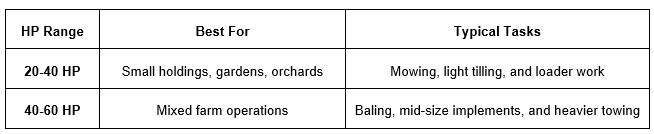
Low HP (20-40 HP) for Small Holdings
This range comfortably covers most small holdings. It’s enough for mowing, light tilling, and general loader work, without the fuel and maintenance costs of a bigger machine. For international markets, highly agile, specialized units like the TAFE 6028 M (24 HP) or the TAFE 6022 (26 HP) are engineered precisely for these tight spaces, delivering great fuel economy and a tight turning radius for orchard row.
Mid HP (40-60 HP) for Mixed Operations
If you’re running livestock alongside crops or handling bigger implements, this band gives more headroom. Many farmers here are looking for the best mid-size tractor for a small farm. It handles a variety of jobs without added weight.
Reliable global workhorses like the classic TAFE 35 DI (36 HP segment) fit perfectly into this transitional space, giving buyers the rugged structural lift capacity needed for commercial multi-crop tasks.
For fields demanding heavier haulage or intensive soil prep, the durable TAFE 45 DI 4WD (47 HP) from the Classic Series and the advanced, high-torque TAFE 5515 4WD (55 HP) from the premium MAGNA 15 Series offer the perfect mid-range power boost without forcing you to scale up to an oversized utility chassis.
Consider Implement Compatibility
Common Implements for Small Farms
The tractor is only half the equation. Match it to the implements you’ll actually use:
-
Rotary mowers and toppers for pasture upkeep
-
Front loaders for material handling and yard work
-
Rear tillers for garden and small-plot cultivation
-
Post-hole diggers and box blades for fencing and groundwork
Suggested Read: Best Tractor Attachments to Upgrade Your Farm Efficiency
3-Point Hitch & PTO Requirements
Check the hitch category and PTO horsepower before buying any implement. Category 1 hitches suit most compact and mid-size tractors, but always confirm before ordering. A mismatch here causes more disappointment than an underpowered engine ever will.
Budget and Brand Reliability
Choosing the best tractor for small farm use also comes down to what you can afford to own over the long term. It’s not just about the purchase price.
Price vs. Features Trade-Off
The entry-level tractor isn’t always the best value. Some buyers want the best all-around tractor for a small farm, not just the lowest sticker price. That’s usually the smarter call. Features like power steering and a comfortable seat pay off daily.
After-Sales Service & Spare Parts Availability
A tractor is only as reliable as the dealer behind it. Check parts availability and service turnaround before you buy, not after something breaks down. A strong dealer network keeps downtime to a minimum during the busiest weeks of the year.
Low-Cost Tractors for Small Farms
Affordable, compact tractors maximize small farm productivity without overextending your operational budget.
-
Compact Utility Models: Small, agile tractors under 30 HP, like the TAFE 6028 M (24 HP, 4WD), the hydrostatic TAFE 6028 H (24 HP, 4WD), and the highly efficient TAFE 6022, offer major fuel savings while navigating tight spaces with ease.
-
Pre-Owned Workhorses: Buying certified used tractors allows you to access premium, high-quality brands at a fraction of the sticker price.
-
Basic Mechanical Builds: Choosing models with fewer electronic components drastically lowers both upfront purchase costs and long-term maintenance fees.
Low-Cost Tractors for Small Farms
Affordable, compact tractors maximize small farm productivity without overextending your operational budget.
-
Compact Utility Models: Small, agile tractors under 30 HP, like the TAFE 6028 M (24 HP, 4WD), the hydrostatic TAFE 6028 H (24 HP, 4WD), and the highly efficient TAFE 6022, offer major fuel savings while navigating tight spaces with ease.
-
Pre-Owned Workhorses: Buying certified used tractors allows you to access premium, high-quality brands at a fraction of the sticker price.
-
Basic Mechanical Builds: Choosing models with fewer electronic components drastically lowers both upfront purchase costs and long-term maintenance fees.
Best Tractor for Small Farm: Final Recommendation
There’s no single best tractor for small farm use. There’s only the one that matches your acreage, terrain, and workload.
Start with the jobs you do every week, then size the horsepower and implements around them. Get that match right, and the tractor pays for itself in time saved, not just fuel.